
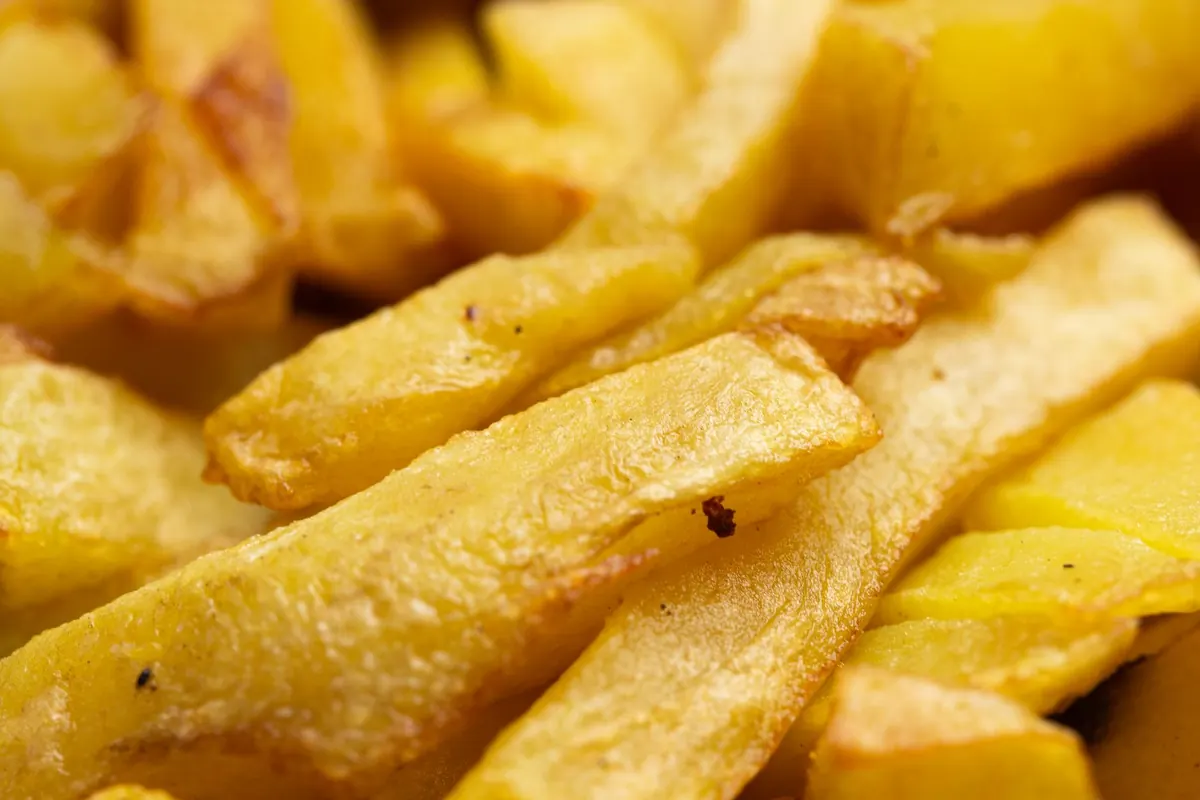
Thin and crunchy, or thick and fluffy? Everyone has a favourite, and most people never think about why. The shape of a fry changes everything: how it tastes, how long it cooks, how much oil it holds and which meal it suits best. Once you understand the cuts, you will start noticing them everywhere.
How do the different fry cuts compare?
| Cut | Size | Texture | Best for |
|---|---|---|---|
| Shoestring | 5 to 7 mm | Very crunchy | Burgers, snacks |
| Straight / regular | 10 to 12 mm | Crisp outside, soft inside | Everything: chips, chipsi mayai, chips kuku |
| Steak / thick | 15 to 20 mm | Fluffy, potato-heavy | Steak, fish and chips, gravy |
| Crinkle | About 10 to 12 mm, ridged | Crisp ridges | Holding sauce, kids |
| Wedges | Thick, skin-on | Soft, roast-potato style | Oven, sharing plates |
| Curly | Thin spiral | Crunchy, often seasoned | Fast food sides |
| Waffle | Lattice slices | Crisp and sturdy | Loaded toppings |
| Skin-on | Any size, skin left on | Rustic, earthy | Burger restaurants |
| Home fries | Cubes or chunks | Pan-fried, soft | Breakfast |
1. Shoestring fries
Thin and crunchy, popular with fast food chains. They cook very quickly but also cool and go limp quickly, so serve them at once.
2. Straight (regular) cut fries
The classic chip: thick enough to stay fluffy, thin enough to crisp well. It works in every Tanzanian chips dish, from chipsi mayai to chips kuku, and it suits deep fryers, air fryers and ovens.
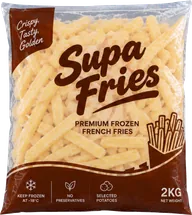
The all-round cut for homes and restaurants. Crisp outside, soft inside, about 3 minutes from frozen.
Order on WhatsApp3. Steak (thick cut) fries
Big, fluffy and filling. They need longer in the fryer and are best with a meal that has sauce or gravy.
4. Crinkle cut fries
The ridges add surface area for crunch and catch more sauce. Children love them.
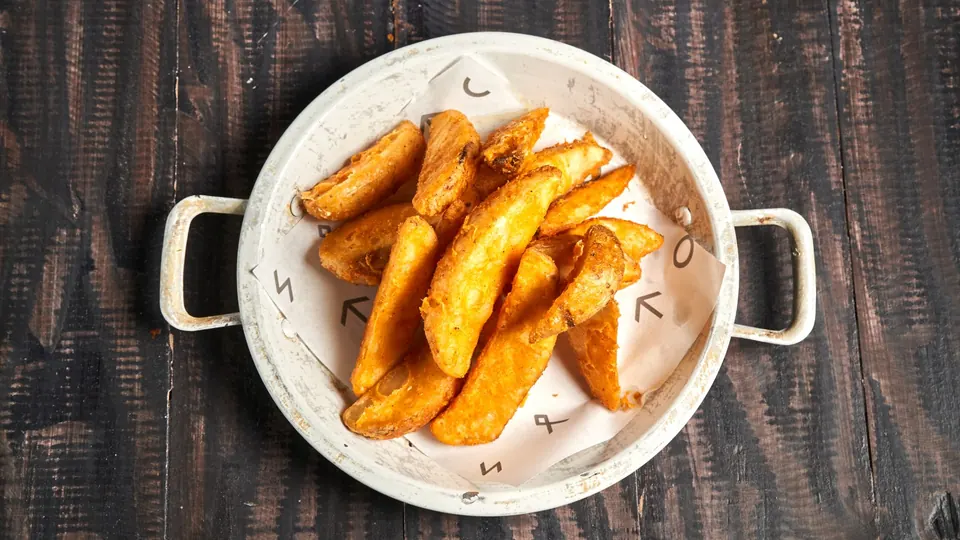
5. Potato wedges
Long thick wedges with the skin on, often seasoned and baked. Great for oven cooking and sharing platters.
6. Curly fries
Spiral-cut and usually coated in a seasoned batter. Fun, but the coating means more oil.
7. Waffle fries
Cut with a special blade into a lattice. Sturdy enough to hold heavy toppings for loaded fries.
8. Skin-on fries
Any cut with the skin left on. They look rustic and keep a little more fibre. Supa Fries can arrange skin-on fries as a custom order.
9. Home fries
Chunks of potato pan-fried with onion and spices. More a breakfast side than a chip.
Which fry cut should a restaurant choose?
Most restaurants do best with one reliable straight cut, because it suits every dish and cooks in a predictable time. Add a second cut only if it earns its freezer space. Read how to choose the best frozen fries for your restaurant, and see the history of the chip on Wikipedia's french fries page.
Why does fry size change taste and texture?
Every fry has two parts: the crisp outer shell and the soft, fluffy inside. Thin fries are mostly shell, so they are crunchy and salty but have little potato flavour inside. Thick fries are mostly inside, so they taste more of potato and stay hot longer, but have less crunch. A medium straight cut of 10 to 12 mm sits in the middle: enough shell to crunch, enough inside to taste like potato. That balance is why it is the most popular cut around the world.
How long does each cut take to cook?
| Cut | Deep fryer, 175°C | Air fryer, 200°C | Oven, 220°C |
|---|---|---|---|
| Shoestring | 2 to 3 min | 8 to 10 min | 12 to 15 min |
| Straight (10 to 12 mm) | About 3 min | 12 to 15 min | 18 to 22 min |
| Steak / thick | 4 to 6 min | 16 to 20 min | 22 to 28 min |
| Wedges | 5 to 7 min | 18 to 22 min | 25 to 30 min |
These are guides for frozen fries; always check the pack and stop at golden. Full instructions in how to cook frozen fries.
Which cut suits which dish?
- Chipsi mayai: straight cut, so the egg can set around the chips. See the recipe.
- Chips kuku and mishkaki: straight cut, the classic plate.
- Burgers: shoestring or straight.
- Fish and chips: thick or steak cut.
- Loaded fries: straight, crinkle or waffle, which hold toppings.
- Sharing platters and oven bakes: wedges.
- Kids: crinkle or straight.
Why do restaurants usually stick to one cut?
One cut means one cooking time, one portion size and one cost per plate. Staff learn exactly how long to fry, every plate looks the same, and you need freezer space for only one product. Adding a second cut makes sense only when it sells enough to earn its place, for example wedges for a sharing menu. Read how to choose the best frozen fries for your restaurant and why restaurants choose Supa Fries.
How do you cut fries evenly at home?
- Peel the potato and trim a thin slice off one side so it sits flat and does not roll.
- Cut the potato lengthways into slabs of 10 to 12 mm.
- Stack two or three slabs and cut them into sticks of the same width.
- Put the sticks straight into cold water so they do not darken.
A simple hand-press chip cutter makes this much faster if you cut fries often. For the whole home method, including blanching and freezing, see how to make frozen fries at home.
Which cuts are popular in different countries?
Belgians prefer thick, double-fried frites; the British like chunky chips with fish; fast food chains in the US popularised thin fries; and East Africa mostly eats a medium straight cut, perfect for chipsi mayai and chips kuku. Read more in french fries around the world.
Does the cut affect cost per portion?
A little. Thin fries look like more on the plate, so a smaller weight can feel like a generous portion. Thick fries look smaller for the same weight but fill people up. Thin fries also absorb more oil per gram because they have more surface area, so oil cost per portion can be slightly higher. For most businesses, a medium straight cut gives the best balance of perceived value, oil use and cooking speed. See chips cost per plate.
Should fries have the skin on or off?
Both are good; it depends on the style you want. Skin-off fries look clean and golden, and they are the classic choice for chipsi mayai, chips kuku and most restaurant plates. Skin-on fries look rustic and homemade, have a slightly earthier flavour, and keep a little more fibre and nutrients from just under the skin. They are popular at burger restaurants and gastropubs.
If you make skin-on fries at home, scrub the potatoes well and cut away any green patches or damaged spots. Green skin should not be eaten. For businesses that want a skin-on product to stand out on the menu, Supa Fries can arrange skin-on fries as a custom order.
Which cut should you buy for home?
For most families, a straight cut is the best single choice. It works in the deep fryer, air fryer, oven and frying pan; it suits every Tanzanian chips dish; it is easy for children to eat; and it reheats well. If you love extra crunch, cook straight-cut fries a minute longer. If you want something different for a party, buy or make wedges for the oven. Keep one main cut in the freezer and you will always be ready for a quick meal. See the 2 kg pack guide for portions and times.
In short
The main types of french fry cuts are shoestring (thin, about 5 to 7 mm), straight or regular (about 10 to 12 mm), steak or thick cut (15 mm or more), crinkle, wedges, curly, waffle, skin-on and home fries. Thinner cuts are crunchier and cook faster; thicker cuts are fluffier inside and hold heat longer. The straight cut is the most popular all-rounder, which is why Supa Fries uses a 10 to 12 mm straight cut.
- Thin fries are crunchier; thick fries are fluffier and stay hot longer.
- The straight cut (10 to 12 mm) is the most popular all-rounder.
- Crinkle and waffle cuts hold sauces and toppings well.
- Restaurants usually do best with one reliable cut.
- Cooking time grows with thickness, so always match time to cut.
Frequently asked questions
What is the most popular type of french fry?
The straight or regular cut, about 10 to 12 mm thick. It is crisp outside, soft inside and works with almost every meal.
What is the difference between fries and chips?
In the US, fries are the long potato sticks and chips are crisps. In the UK and East Africa, chips usually means the same thing as fries, often a little thicker.
Are thin or thick fries better?
Thin fries are crunchier and cook faster; thick fries are fluffier and stay hot longer. Medium straight cut fries give a balance of both.
What size are Supa Fries?
Supa Fries are a straight cut of 10 to 12 mm. Other cuts, including skin-on, can be arranged as custom orders.
What is the best cut for chipsi mayai?
A straight cut of about 10 to 12 mm. It is sturdy enough for the egg to set around without breaking up.
Do thick fries have fewer calories than thin fries?
Usually yes, per gram, because thick fries have less surface area to absorb oil than thin fries.
Which cut is best for an air fryer?
Straight and crinkle cuts work very well. Very thin fries can dry out, and very thick ones take longer.
Do thin fries use more oil?
Yes, slightly. They have more surface area per gram, so they absorb a little more oil than thick fries.
Are skin-on fries healthier?
Slightly. The skin adds a little fibre and some nutrients, but the cooking method and portion size matter much more.
Get Supa Fries delivered
Found this useful? Share it.